jonCates
Thursday, November 13, 2008
GAIN ON - RECORDING PRODUCTIONS
GAIN ON - RECORDING PRODUCTIONS
http://www.recordingproductions.com/machinima/gainon.html
"GAIN ON" is an 8-bit machinima video short by RECORDING PRODUCTIONS. It is a small, music-driven adventure in which our hero continually attempts to transcend his environment. Arcade and NES games were played, captured, and processed to create this video at the Experimental Television Center in Owego, NY. Original score and final edit were completed at RECORDING PRODUCTIONS' New York studio." - RECORDING PRODUCTIONS

GAIN ON - RECORDING PRODUCTIONS
http://www.recordingproductions.com/machinima/gainon.html
"GAIN ON" is an 8-bit machinima video short by RECORDING PRODUCTIONS. It is a small, music-driven adventure in which our hero continually attempts to transcend his environment. Arcade and NES games were played, captured, and processed to create this video at the Experimental Television Center in Owego, NY. Original score and final edit were completed at RECORDING PRODUCTIONS' New York studio." - RECORDING PRODUCTIONS
Labels: edu, FVNM, machinima, SAIC
¶ 11:11 PM 0 Comments
Wednesday, November 12, 2008
my New Media 01 next semester

i am teaching New Media 01 next semester (SPRING 2009). New Media 01 introduces the skills and ideas needed for New Media Art making in the Film, Video & New Media department @ The School of the Art Institute of Chicago. Students create, transcode and remix New Media Art. New Media 01 is the prerequisite for all classes in the New Media Path of the department.
Topics and skills covered incl:
* data-bending
* Art Games
* Machinima
* realtime audio-video
* software-as-art/art-as-software
* Hacker/Cracker Art
* Free & Open Source Software Culture
* blogs, vlogs + RSS feeds as Art
courses that follow New Media 01 in the New Media path of FVNM incl:
dotVideo (FVNM 3810)
Realtime (FVNM 3812)
Lost Signals: The Glitch (FVNM 4013)
Radical Software Critical Artware (FVNM 4830)
IF (FVNM 4860)
Machinima (FVNM 4866)
playFull, playMe (FVNM 4865)
OnEvent (FVNM 4867)
0850LEET (FVNM 4225)

i am teaching New Media 01 next semester (SPRING 2009). New Media 01 introduces the skills and ideas needed for New Media Art making in the Film, Video & New Media department @ The School of the Art Institute of Chicago. Students create, transcode and remix New Media Art. New Media 01 is the prerequisite for all classes in the New Media Path of the department.
Topics and skills covered incl:
* data-bending
* Art Games
* Machinima
* realtime audio-video
* software-as-art/art-as-software
* Hacker/Cracker Art
* Free & Open Source Software Culture
* blogs, vlogs + RSS feeds as Art
courses that follow New Media 01 in the New Media path of FVNM incl:
dotVideo (FVNM 3810)
Realtime (FVNM 3812)
Lost Signals: The Glitch (FVNM 4013)
Radical Software Critical Artware (FVNM 4830)
IF (FVNM 4860)
Machinima (FVNM 4866)
playFull, playMe (FVNM 4865)
OnEvent (FVNM 4867)
0850LEET (FVNM 4225)
Labels: edu, FVNM, Media Art, New Media 01, new media art, SAIC
¶ 4:02 PM 0 Comments
my Graduate Seminar next semester
 next semester (SPRING 2009) i am teaching a Graduate Seminar on the topic of experimental Media Art Histories as filtered through Chronophobia (both the book Chronophobia: On Time in the Art of the 1960's by Pamela M. Lee + the condition which is the fear of the duration or immensity of time). in particular we will compare these issues with their manifestations in New Media Art, particularly Art Games. to do this we will read from Game Studies + Game Theory the ways in which time plays out in games. time in games is often measured against the threat of one's own "imminent symbolic death" in the game. this will be the conceptual framework for our readings, screenings + discussions.
 next semester (SPRING 2009) i am teaching a Graduate Seminar on the topic of experimental Media Art Histories as filtered through Chronophobia (both the book Chronophobia: On Time in the Art of the 1960's by Pamela M. Lee + the condition which is the fear of the duration or immensity of time). in particular we will compare these issues with their manifestations in New Media Art, particularly Art Games. to do this we will read from Game Studies + Game Theory the ways in which time plays out in games. time in games is often measured against the threat of one's own "imminent symbolic death" in the game. this will be the conceptual framework for our readings, screenings + discussions.
Labels: Chronophobia, edu, FVNM, Media Art, Media Art Histories, new media art, SAIC
¶ 3:38 PM 0 Comments
Monday, November 10, 2008
Notes from Media Practices discussion of Final Collaborative Projects
Notes from Media Practices discussion of Final Collaborative Projects
What is software?
software-as-art/art-as-software
New Media Art
Software Art
Artware
experimental Media Art
instructions, rule sets or programs for generating experimental Media Art

runme.org - Amy Alexander, Florian Cramer, Matthew Fuller, Olga Goriunova, Thomax Kaulmann, Alex McLean, Pit Schultz, Alexei Shulgin, The Yes Men, Hans Bernhard and Alessandro Ludovico (2003 - present)
http://runme.org

"Change gradually from a smile to no smile."
Disappearing Music for Face - Mieko Shiomi (1964)

"1. Filming must be done on location. Props and sets must not be brought in (if a particular prop is necessary for the story, a location must be chosen where this prop is to be found).
2. The sound must never be produced apart from the images or vice versa. (Music must not be used unless it occurs within the scene being filmed, i.e., diegetic).
3. The camera must be a hand-held camera. Any movement or immobility attainable in the hand is permitted. (The film must not take place where the camera is standing; filming must take place where the action takes place.)
4. The film must be in colour. Special lighting is not acceptable. (If there is too little light for exposure the scene must be cut or a single lamp be attached to the camera).
5. Optical work and filters are forbidden.
6. The film must not contain superficial action. (Murders, weapons, etc. must not occur.)
7. Temporal and geographical alienation are forbidden. (That is to say that the film takes place here and now.)
8. Genre movies are not acceptable.
9. The final picture must be transferred to the Academy 35mm film, with an aspect ratio of 4:3, that is, not widescreen. (Originally, the requirement was that the film had to be filmed on Academy 35mm film, but the rule was relaxed to allow low-budget productions.)
10. The director must not be credited."
Dogme 95 - Lars von Trier and Thomas Vinterberg (1995)

Learning To Love You More - Miranda July and Harrell Fletcher (2002 - present)
http://www.learningtoloveyoumore.com
The Art of Participation - San Francisco Museum of Modern Art (2008)
Final Collaborative Project for Media Practices Discussion:
1. SET RULES/CONSTRAINTS/INSTRUCTIONS
2. DETERMINE HOW THEY WILL BE EXECUTED
3. WHAT MEDIUM/MEDIA WILL YOU USE?
4. CONSIDER PREPARATIONS FOR PRESENTATION
5. WHAT ARE THE MECHANICS OF YOUR COLLABORATION? WHAT ARE YOUR ROLES OR RESPONSIBILITIES?
What is software?
software-as-art/art-as-software
New Media Art
Software Art
Artware
experimental Media Art
instructions, rule sets or programs for generating experimental Media Art

runme.org - Amy Alexander, Florian Cramer, Matthew Fuller, Olga Goriunova, Thomax Kaulmann, Alex McLean, Pit Schultz, Alexei Shulgin, The Yes Men, Hans Bernhard and Alessandro Ludovico (2003 - present)
http://runme.org

"Change gradually from a smile to no smile."
Disappearing Music for Face - Mieko Shiomi (1964)

"1. Filming must be done on location. Props and sets must not be brought in (if a particular prop is necessary for the story, a location must be chosen where this prop is to be found).
2. The sound must never be produced apart from the images or vice versa. (Music must not be used unless it occurs within the scene being filmed, i.e., diegetic).
3. The camera must be a hand-held camera. Any movement or immobility attainable in the hand is permitted. (The film must not take place where the camera is standing; filming must take place where the action takes place.)
4. The film must be in colour. Special lighting is not acceptable. (If there is too little light for exposure the scene must be cut or a single lamp be attached to the camera).
5. Optical work and filters are forbidden.
6. The film must not contain superficial action. (Murders, weapons, etc. must not occur.)
7. Temporal and geographical alienation are forbidden. (That is to say that the film takes place here and now.)
8. Genre movies are not acceptable.
9. The final picture must be transferred to the Academy 35mm film, with an aspect ratio of 4:3, that is, not widescreen. (Originally, the requirement was that the film had to be filmed on Academy 35mm film, but the rule was relaxed to allow low-budget productions.)
10. The director must not be credited."
Dogme 95 - Lars von Trier and Thomas Vinterberg (1995)

Learning To Love You More - Miranda July and Harrell Fletcher (2002 - present)
http://www.learningtoloveyoumore.com
The Art of Participation - San Francisco Museum of Modern Art (2008)
Final Collaborative Project for Media Practices Discussion:
1. SET RULES/CONSTRAINTS/INSTRUCTIONS
2. DETERMINE HOW THEY WILL BE EXECUTED
3. WHAT MEDIUM/MEDIA WILL YOU USE?
4. CONSIDER PREPARATIONS FOR PRESENTATION
5. WHAT ARE THE MECHANICS OF YOUR COLLABORATION? WHAT ARE YOUR ROLES OR RESPONSIBILITIES?
Labels: edu, FVNM, Media Practices, SAIC
¶ 4:03 PM 0 Comments
Monday, November 03, 2008
notes from Installation discussion in Media Practices
Marshall McLuhan: media environments; Media Studies; The Medium is the Message; probes
Installation Art; Media Art; Video Art; New Media Art
environmental media
inhabitable; art + life; art as environments vs objects or images; architectural
in museums + galleries or alternative spaces; or outside, i.e. site specific; or in artist constructed spaces
Land Art; Environmental Art; Earthworks
hard to sell, confronts commodification but Video Installation is increasingly more saleable now


 merzbau - Kurt Schwitters (1923)
 The Cabinet of Dr. Caligari - Robert Wiene (1920)
 Skyspace - James Turrell
 Sky TV - Yoko Ono (1966)
 The Golden Calf - Jeffery Shaw (1994)
Installation Art; Media Art; Video Art; New Media Art
environmental media
inhabitable; art + life; art as environments vs objects or images; architectural
in museums + galleries or alternative spaces; or outside, i.e. site specific; or in artist constructed spaces
Land Art; Environmental Art; Earthworks
hard to sell, confronts commodification but Video Installation is increasingly more saleable now


 merzbau - Kurt Schwitters (1923)
 The Cabinet of Dr. Caligari - Robert Wiene (1920)
 Skyspace - James Turrell
 Sky TV - Yoko Ono (1966)
Expanded Cinema: expanded consciousness, psychedelics, cybernetics
interactivity + New Media Art
Interactive Installation
interactivity + New Media Art
Interactive Installation
 The Golden Calf - Jeffery Shaw (1994)
Simultaneity
Relational Aesthetics, Relational Art or Relationalism
Relational Aesthetics, Relational Art or Relationalism

Labels: art, edu, FVNM, Media Practices, SAIC, video, video art
¶ 10:34 AM 0 Comments
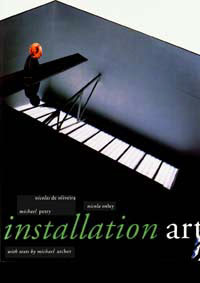
MEDIA by Michael Archer from Installation Art
"MEDIA
The colonization by artists of the dream and desiring spaces of the media has been of specific political significance. Think, for example, of Barbara Kruger's use of the language of advertising, of Krzysztof Wodiczko's projections or the video installations of Dara Birnbaum, Nam June Paik, Marie-Jo Lafontaine and Gary Hill, and of the words of the U.S. artist Jenny Holzer which you find stuck up in phone booths, flickering across LED displays and pumping out from spectacolor advertising boards:
PROTECT ME FROM WHAT I WANT.
GO WHERE PEOPLE SLEEP AND SEE IF THEY'RE SAFE.
IT TAKES AWHILE BEFORE YOU CAN STEP OVER INERT BODIES AND GO AHEAD WITH WHAT YOU WERE WANTING TO DO.
Although these sentences are not specific they never the less refer in a very direct way to some of the major issues of contemporary existence - AIDS, homelessness, hunger and so on. A key feature of an art like this is that as well as delivering its message, it does so in terms which draw upon the way in which such problems are represented in the media. It is the mode of experience that matters, as much as what it is an experience of.
In the 1920's Laszlo Moholy-Nagy recognized that photography provided us with something else besides its extraordinary ability to represent the world. The 'photogram' or 'camera-less record of forms produced by light' freed photographic technologies from its dependent, reproductive function and indicated that it was 'in a fair way to bringing (optically) something entirely new into the world.' What Moholy-Nagy's 'painting with light' revel is that the manipulation of a medium creates its own space which, unlike the perspectival space of post-Renaissance painting, does not refer to 'real' space but exists alongside it. By extension, many more such 'technological spaces' can be entered by for example, switching on a video monitor, TV set, turntable, slide projector or tape deck. All these media, in addition to possessing the capability to record and represent an event to a spectator in another time and place to that in which it occurred, engender a mode of experience which is quite particular to themselves.
We inhabit these technological environments as much physically as psychologically, a fact which media theorist Marshall McLuhan perceived clearly. Writing in the early sixties he considered how the possibilities opened up by these new spaces radically undercut the conventional tendency to evaluate the cultural experience along the avant garde/kitsch axis. It is the 'depth of experience' provided by the electronic media that erodes the importance of distinctions such as 'high' and 'low' because:
[A]nything that is approached in depth acquires as much interest as the greatest matters. Because 'depth' means 'in interrelation', not isolation. Depth means insght, not point of view; and insight is a kind of mental involvement in process that makes the content of the item seem quite secondary.
Some from the loose association of artists around George Maciunas, known as Fluxus and working both in Germany and the U.S., began to explore these media spaces from the late fifties onwards. Nam June Paik in his work, first with sound and subsequently with video, offered situations in which the audience could interact with the technology, constructing their own 'messages' and thereby challenging the impenetrable authority of the media. For Random Access he cut up a pool of recorded tape and stuck the strips haphazardly on a wall. Playback equipment was provided with a portable head so that one could draw it across the desired selections of tape. Similarly, later set-ups allowed viewers to manipulate magnetic fields or feed sound signals into a TV monitor in order to modify and distort the image on the screen. Wolf Vostell incorporated television screens into paintings.
The limit case of this opening up of new environments. or at least, the one which preoccupies us at present, is the computerized world of virtual reality. Writing of virtual reality or cyberspace technology in 1990, Regina Cornwell said: 'The media has already pounced on it as the psychedelia of the 90s, of the telepornograhy of the future.' We witness this when, for example, we are priveleged with a 'missile's eye view' of the destruction of Baghdad and the compturized target-location of the bomber pilots during the Gulf War. 'This Nintendo war', Aimee Morgana called it. In general, bearing witness to the workings of the mass media by, for example, watching a film or TV programme, or listening to a record, implicates the viewer/listener as a straightforward consumer of spectacle. The majority of the artists in this section, from Peter Fend's proposals for the reshaping of the geopolitical map through Antoni Muntadas's reflection on the phenomenon of television evangelism to Christian Marclay's irreverent treatment of long-playing records, use information technology and the conventions of mass communications to destabilize the authority and power of that spectacle."
from: Installation Art - by by Nicolas de Oliveira, Nicola Oxley, Michael Petry, Michael Archer (1994)

"MEDIA
The colonization by artists of the dream and desiring spaces of the media has been of specific political significance. Think, for example, of Barbara Kruger's use of the language of advertising, of Krzysztof Wodiczko's projections or the video installations of Dara Birnbaum, Nam June Paik, Marie-Jo Lafontaine and Gary Hill, and of the words of the U.S. artist Jenny Holzer which you find stuck up in phone booths, flickering across LED displays and pumping out from spectacolor advertising boards:
PROTECT ME FROM WHAT I WANT.
GO WHERE PEOPLE SLEEP AND SEE IF THEY'RE SAFE.
IT TAKES AWHILE BEFORE YOU CAN STEP OVER INERT BODIES AND GO AHEAD WITH WHAT YOU WERE WANTING TO DO.
Although these sentences are not specific they never the less refer in a very direct way to some of the major issues of contemporary existence - AIDS, homelessness, hunger and so on. A key feature of an art like this is that as well as delivering its message, it does so in terms which draw upon the way in which such problems are represented in the media. It is the mode of experience that matters, as much as what it is an experience of.
In the 1920's Laszlo Moholy-Nagy recognized that photography provided us with something else besides its extraordinary ability to represent the world. The 'photogram' or 'camera-less record of forms produced by light' freed photographic technologies from its dependent, reproductive function and indicated that it was 'in a fair way to bringing (optically) something entirely new into the world.' What Moholy-Nagy's 'painting with light' revel is that the manipulation of a medium creates its own space which, unlike the perspectival space of post-Renaissance painting, does not refer to 'real' space but exists alongside it. By extension, many more such 'technological spaces' can be entered by for example, switching on a video monitor, TV set, turntable, slide projector or tape deck. All these media, in addition to possessing the capability to record and represent an event to a spectator in another time and place to that in which it occurred, engender a mode of experience which is quite particular to themselves.
We inhabit these technological environments as much physically as psychologically, a fact which media theorist Marshall McLuhan perceived clearly. Writing in the early sixties he considered how the possibilities opened up by these new spaces radically undercut the conventional tendency to evaluate the cultural experience along the avant garde/kitsch axis. It is the 'depth of experience' provided by the electronic media that erodes the importance of distinctions such as 'high' and 'low' because:
[A]nything that is approached in depth acquires as much interest as the greatest matters. Because 'depth' means 'in interrelation', not isolation. Depth means insght, not point of view; and insight is a kind of mental involvement in process that makes the content of the item seem quite secondary.
Some from the loose association of artists around George Maciunas, known as Fluxus and working both in Germany and the U.S., began to explore these media spaces from the late fifties onwards. Nam June Paik in his work, first with sound and subsequently with video, offered situations in which the audience could interact with the technology, constructing their own 'messages' and thereby challenging the impenetrable authority of the media. For Random Access he cut up a pool of recorded tape and stuck the strips haphazardly on a wall. Playback equipment was provided with a portable head so that one could draw it across the desired selections of tape. Similarly, later set-ups allowed viewers to manipulate magnetic fields or feed sound signals into a TV monitor in order to modify and distort the image on the screen. Wolf Vostell incorporated television screens into paintings.
The limit case of this opening up of new environments. or at least, the one which preoccupies us at present, is the computerized world of virtual reality. Writing of virtual reality or cyberspace technology in 1990, Regina Cornwell said: 'The media has already pounced on it as the psychedelia of the 90s, of the telepornograhy of the future.' We witness this when, for example, we are priveleged with a 'missile's eye view' of the destruction of Baghdad and the compturized target-location of the bomber pilots during the Gulf War. 'This Nintendo war', Aimee Morgana called it. In general, bearing witness to the workings of the mass media by, for example, watching a film or TV programme, or listening to a record, implicates the viewer/listener as a straightforward consumer of spectacle. The majority of the artists in this section, from Peter Fend's proposals for the reshaping of the geopolitical map through Antoni Muntadas's reflection on the phenomenon of television evangelism to Christian Marclay's irreverent treatment of long-playing records, use information technology and the conventions of mass communications to destabilize the authority and power of that spectacle."
from: Installation Art - by by Nicolas de Oliveira, Nicola Oxley, Michael Petry, Michael Archer (1994)
Labels: art, edu, FVNM, Media Practices, SAIC, video, video art
¶ 7:23 AM 0 Comments
Notes on Expanded Cinema

 Stan Vanderbeek (January 6, 1927 - September 19, 1984)

"Influenced by Buckminster Fuller’s spheres, VanDerBeek had the idea for a spherical theater where people would lie down and experience movies all around them. Floating multi-images would replace straight one-dimensional film projection. From 1957 on, VanDerBeek produced film sequences for the Movie-Drome, which he started building in 1963. His intention went far beyond the building itself and moved into the surrounding biosphere, the cosmos, the brain and even extraterrestrial intelligence."
 Wipe Cycle - Frank Gillette and Ira Schneider (1969)
"Unlike Levine's work, the effect of Wipe Cycle, by the young New York artists Frank Gillette and Ira Schneider, was to integrate the viewer and his local environment into the larger macrosystem of information transmission. Wipe Cycle was first exhibited at the Howard Wise Gallery in New York in 1969. It consisted of nine monitors whose displays were controlled by synchronized cycle patterns of live and delayed feedback, broadcast television, and taped programming shot by Gillette and Schneider with portable equipment. These were displayed through alternations of four programmed pulse signals every two, four, eight, and sixteen seconds. Separately, each of the cycles acted as a layer of video information, while all four levels in concert determined the overall composition of the work at any given moment.
"The most important function of Wipe Cycle," Schneider explained, "was to integrate the audience into the information. It was a live feedback system which enabled the viewer standing within its environment to see himself not only now in time and space, but also eight seconds ago and sixteen seconds ago. In addition he saw standard broadcast images alternating with his own delayed/live image. And also two collage-type programmed tapes, ranging from a shot of the earth, to outer space, to cows grazing, and a 'skin flick' bathtub scene."
"It was an attempt," Gillette added, "to demonstrate that you're as much a piece of information as tomorrow morning's headlines— as a viewer you take a satellite relationship to the information. And the satellite which is you is incorporated into the thing which is being sent back to the satellite. In other words, rearranging one's experience of information reception."8 Thus in Wipe Cycle several levels of time and space were synthesized into one audio-visual
experience on many simultaneous frequencies of perception. What is, what has been, and what could be, were merged into one engrossing teledynamic continuum and the process of
communication was brought into focus." (from: Closed-Circuit Television and Teledynamic Environments, Expanded Cinema; Gene Youngblood; p. 341 - 343)


"EVE is a research and development project initiated at the ZKM Karlsruhe in cooperation with the Forschungszentrum Karlsruhe. It encompasses the conceptual and technical development of a new form of interactive immersive visualisation environment and virtual-reality apparatus.
In the centre of a large inflatable dome, two video projectors are mounted on a motorised pan/tilt device (e.g. robot arm) which can move the projected image anywhere over the inside surface of the dome. The two video projectors present a stereo pair of images - the viewers wearing polarising spectacles can see the projected imagery in three dimensions.
One of the visitors to EVE wears a helmet (or a 'miner's lamp') with an attached spatial tracking device that identifies the position and angle of his head. This controls the positioning of video projectors so that the projected image always follows the direction of the viewer's gaze. In this way the viewer can move the picture frame over the entire dome surface and interactively explore the computer-generated virtual scenographies which are presented there. A joystick also allows the viewer to control his forwards and backwards movement in the surrounding virtual space."
(from: Jeffrey Shaw's website)

Expanded Cinema - Gene Youngblood (1970)
 Stan Vanderbeek (January 6, 1927 - September 19, 1984)
Movie-Drome - Stan VanDerBeek (1963)
"Influenced by Buckminster Fuller’s spheres, VanDerBeek had the idea for a spherical theater where people would lie down and experience movies all around them. Floating multi-images would replace straight one-dimensional film projection. From 1957 on, VanDerBeek produced film sequences for the Movie-Drome, which he started building in 1963. His intention went far beyond the building itself and moved into the surrounding biosphere, the cosmos, the brain and even extraterrestrial intelligence."
(from: Jürgen Claus in Leonardo, Vol. 36, No. 3, 2003, p. 229.)
 Wipe Cycle - Frank Gillette and Ira Schneider (1969)
"Unlike Levine's work, the effect of Wipe Cycle, by the young New York artists Frank Gillette and Ira Schneider, was to integrate the viewer and his local environment into the larger macrosystem of information transmission. Wipe Cycle was first exhibited at the Howard Wise Gallery in New York in 1969. It consisted of nine monitors whose displays were controlled by synchronized cycle patterns of live and delayed feedback, broadcast television, and taped programming shot by Gillette and Schneider with portable equipment. These were displayed through alternations of four programmed pulse signals every two, four, eight, and sixteen seconds. Separately, each of the cycles acted as a layer of video information, while all four levels in concert determined the overall composition of the work at any given moment.
"The most important function of Wipe Cycle," Schneider explained, "was to integrate the audience into the information. It was a live feedback system which enabled the viewer standing within its environment to see himself not only now in time and space, but also eight seconds ago and sixteen seconds ago. In addition he saw standard broadcast images alternating with his own delayed/live image. And also two collage-type programmed tapes, ranging from a shot of the earth, to outer space, to cows grazing, and a 'skin flick' bathtub scene."
"It was an attempt," Gillette added, "to demonstrate that you're as much a piece of information as tomorrow morning's headlines— as a viewer you take a satellite relationship to the information. And the satellite which is you is incorporated into the thing which is being sent back to the satellite. In other words, rearranging one's experience of information reception."8 Thus in Wipe Cycle several levels of time and space were synthesized into one audio-visual
experience on many simultaneous frequencies of perception. What is, what has been, and what could be, were merged into one engrossing teledynamic continuum and the process of
communication was brought into focus." (from: Closed-Circuit Television and Teledynamic Environments, Expanded Cinema; Gene Youngblood; p. 341 - 343)


EVE - Jeffery Shaw (1993)
"EVE is a research and development project initiated at the ZKM Karlsruhe in cooperation with the Forschungszentrum Karlsruhe. It encompasses the conceptual and technical development of a new form of interactive immersive visualisation environment and virtual-reality apparatus.
In the centre of a large inflatable dome, two video projectors are mounted on a motorised pan/tilt device (e.g. robot arm) which can move the projected image anywhere over the inside surface of the dome. The two video projectors present a stereo pair of images - the viewers wearing polarising spectacles can see the projected imagery in three dimensions.
One of the visitors to EVE wears a helmet (or a 'miner's lamp') with an attached spatial tracking device that identifies the position and angle of his head. This controls the positioning of video projectors so that the projected image always follows the direction of the viewer's gaze. In this way the viewer can move the picture frame over the entire dome surface and interactively explore the computer-generated virtual scenographies which are presented there. A joystick also allows the viewer to control his forwards and backwards movement in the surrounding virtual space."
(from: Jeffrey Shaw's website)
Labels: art, edu, FVNM, Media Practices, SAIC, video, video art
¶ 6:59 AM 0 Comments